Spelling Tests:
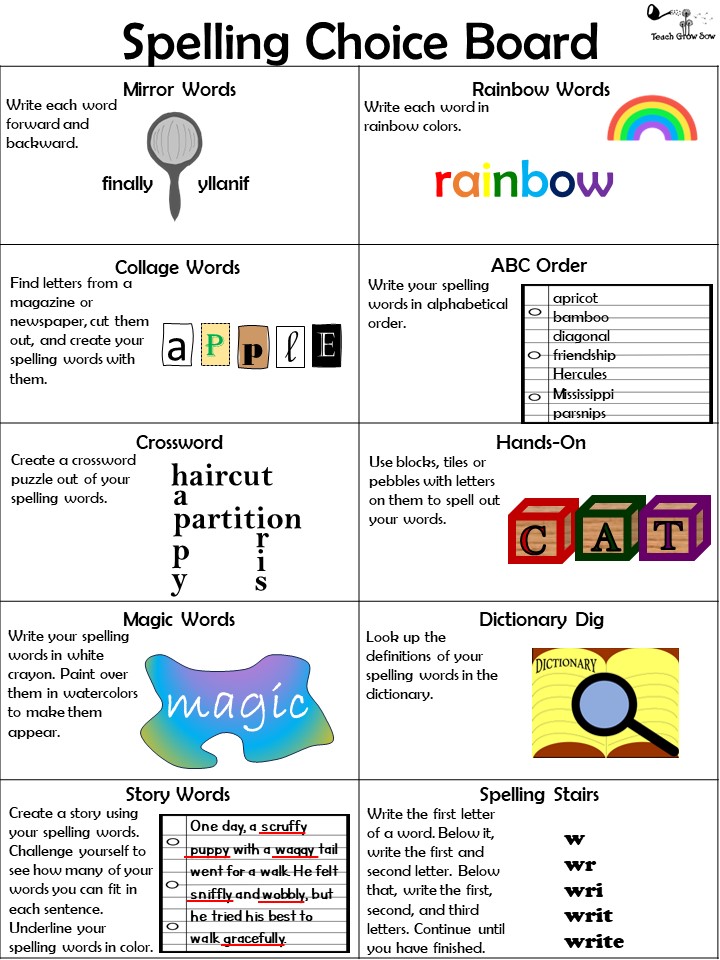
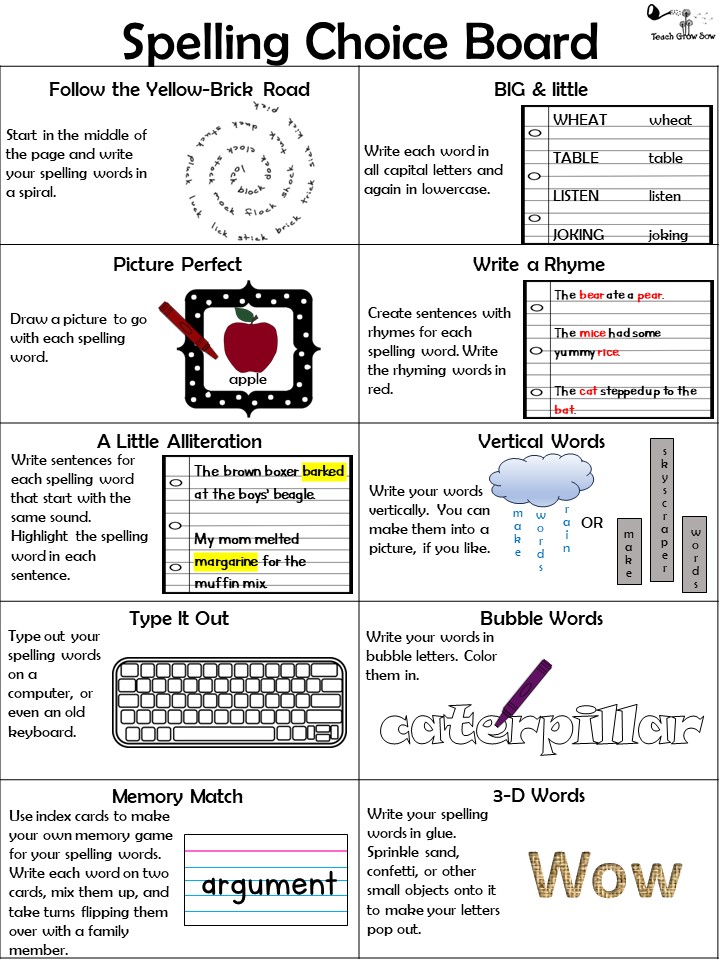
Spelling Choice Board:
Use these fun activities to give children options for practicing their spelling lists independently.

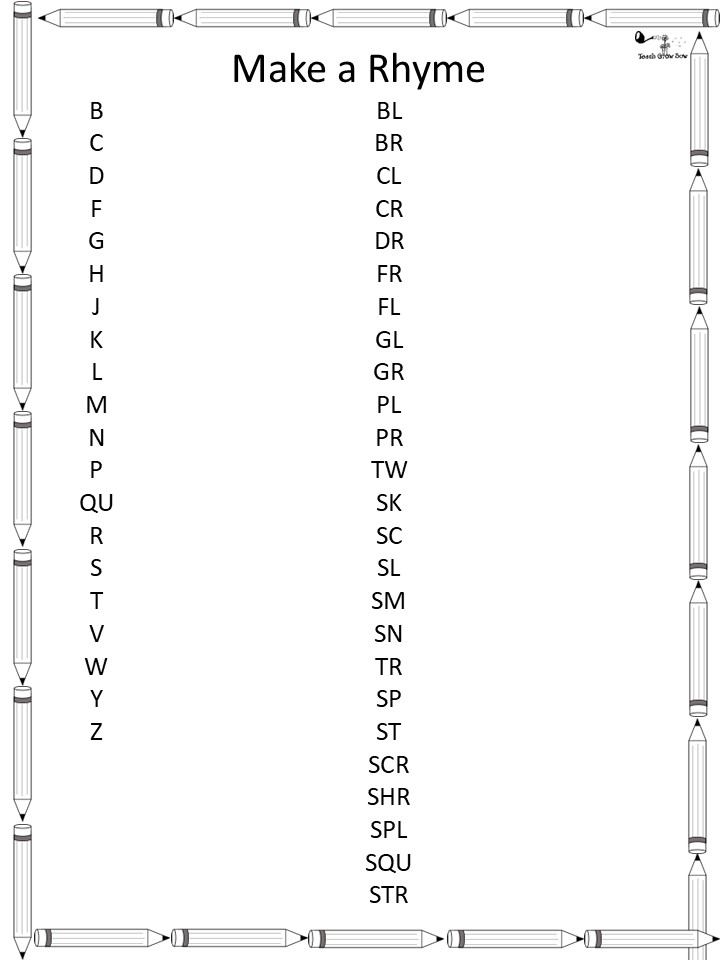
Use this sheet to help children find rhymes for spelling words.
Weekly Instructional Routines
Try making a routine where each day has a set instructional spelling activity. Such as:
Monday: Elkonin boxes
Tuesday: Sort words by spelling pattern
Wednesday: Alphabetize words
Thursday: Write a class story/Do a pre-test
Elkonin Boxes

Guide students to sound out each sound in a word (not each letter). Count the number of sounds and draw that many boxes. For example:
Phone has three sounds. /f/ /o/ /n/
Draw three boxes.
Ask, “What is the first sound you hear?”
/f/
How can we spell /f/?
F, FF, or PH
Write all options below the first box. We can cross out the double F because that only comes at the end of a one-syllable word with a short vowel.
Continue with the other sounds.
Guide children to choose the best option based on the phonics spelling rules they have learned. Explain that sometimes, you have to make the best guess based on what looks right, if a rule doesn’t apply. This is particularly helpful for daily writing, when it is better to spell a word slightly wrong, than completely wrong (drastick vs jraschek).
Jumbo Spelling Words
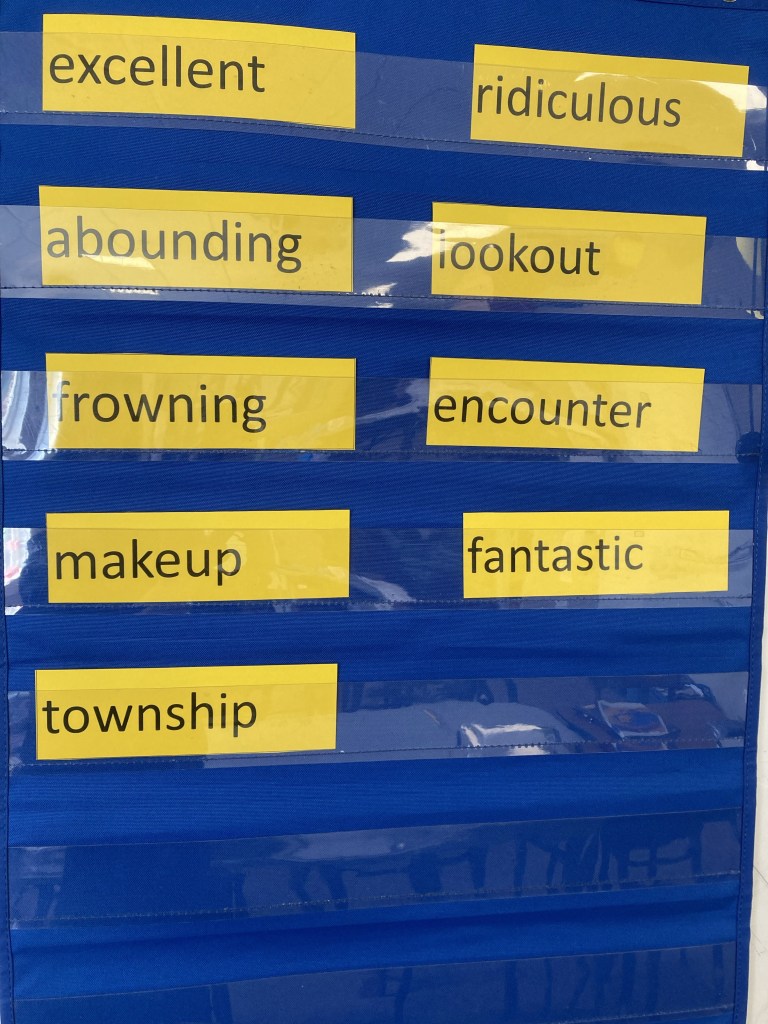
A great resource that is free to make and easy to reuse is jumbo spelling words. Rather than write out your spelling words on the board each week, type them out in big, bold print, print onto card stock, and cut. Place them in a hanging pocket chart. You can also make thin or dotted lines between each letter. Not only will this save time if your curriculum uses the same spelling lists each year, it can turn many verbal activities into tactile activities.
Pattern Sort
Bring students to the rug with the list of words. Divide them among students. Ask, “Who has words that make the /ow/ sound spelled OU?” All those students bring their words up and place them in a column. Continue with each spelling pattern, also leaving a column for rule-breakers.
Alphabetizing
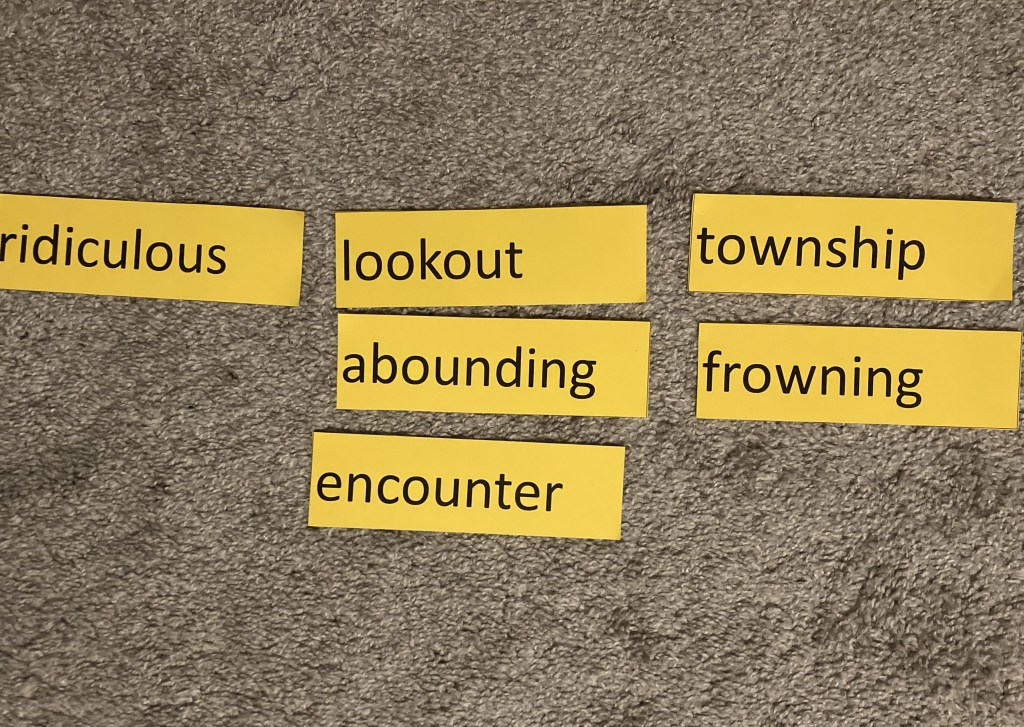
Bring students to the rug with the list of words. Divide them among students. Ask, “Does anyone have a word that begins with A?” Have all students with A words place them in the middle. Line them up and look at the second letters. Move the words up and down in the column until they are alphabetized to the second letter. Continue with third letter, etc, until all the words are alphabetized. Continue asking for each letter of the alphabet, even if you know there are no words that begin with it.
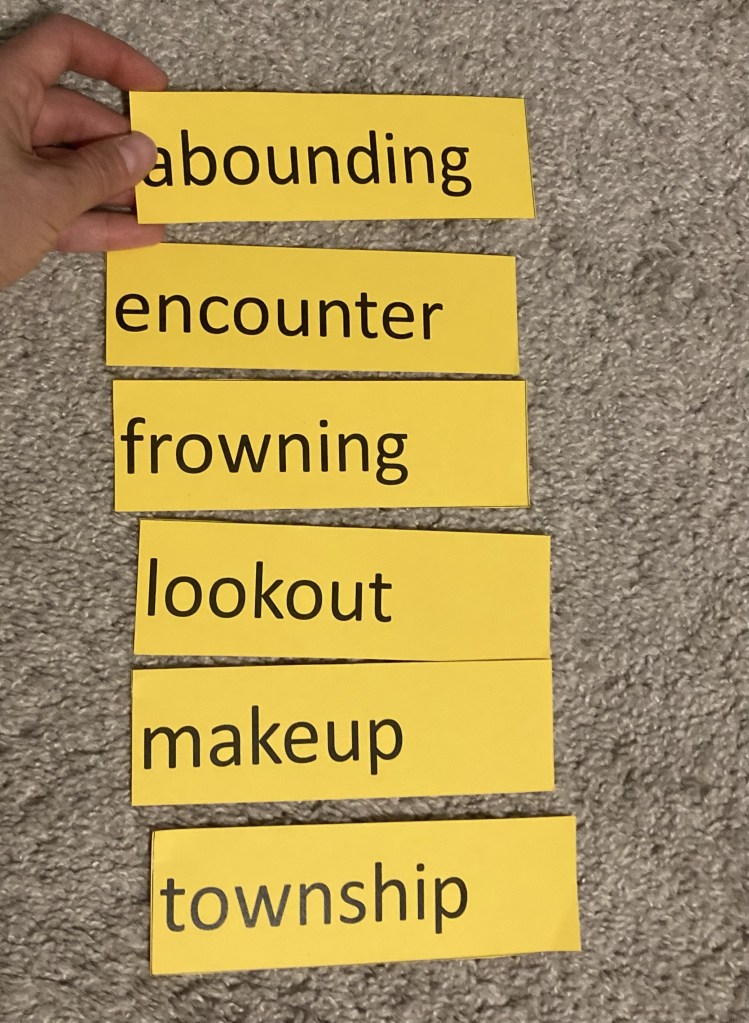
Write a Class Story
Have the words in a shuffled pile, face down. Call each student up one at a time to take the top word from the pile, and make a sentence with it. Each sentence should continue the same story. The teacher has veto power over any sentences that are mean, too far off topic, or inappropriate. If students call out during someone else’s turn, they lose their next turn. Students can each write their sentence on the board, one student can be assigned as the scribe (if doing this in smaller groups), or the teacher can transcribe as students speak, so that the words appear on the board in real time. Later, print these stories and turn them into a class book to go in your class library. Add to it each week. Students will love re-reading their stories.
This activity can also be incorporated into a holiday party (create a Valentines story, a 100th day of school story, or a Thanksgiving story using spelling words).
Tactile/Kinesthetic Spelling Practice
Help children memorize their spelling words using all their senses. As you chant each letter, try some of these activities.
- Clap
- Snap
- Slap sides of legs
- Stomp feet
- Tug ears
- Tap nose or chin
- Pat head
- Hunch shoulders
- Touch both elbows
- Touch thumbs to opposite pinkies
- Tap knees
- Use castanets
- Bounce a ball
- Tap thumb fingernails against each fingertip, then tap each fingernail against the thumb pads
- Use sign language
- Write the letters on the palm of the hand
- Alternate clapping in front and behind torso
- Thump on chest
- Clap under a raised leg
- Toss a beanbag back and forth between two partners
When tapping out words, shout capital letters, whisper silent letters, and say double letters digraphs, and diphthongs together at double speed (unless double are each being pronounced separately, such as accent or suggest).
Spelling Retention
Worried that your students are just studying for the test and then forgetting? Here are some ways to help keep spelling words from fading into the past.
Once a month, do a just-for-fun spelling bee with previous list words. Can maybe have a small prize for the winner.
Have students each contribute to a picture dictionary of the spelling words. Add pages to a 3-ring binder each week and keep it in your class library.
Give nightly homework, rather than a weekly packet. This ensures students aren’t just cramming Thursday night, getting 100 on their Friday quiz, and forgetting the spellings by Monday morning.
Have bonus spelling words on each weekly test (gain one point if correct, lose nothing if wrong). Bonus words will be a surprise each week, but will be taken from previous lists.
Have children save all their old spelling lists in their binders to use as a personal dictionary when checking their writing. Or, put the spelling lists into a three-brad folder and keep it in each child’s writing folder. Add a new list each week as it’s finished & have them use this to proofread their writing projects.
Spelling Test Methods
Spelling tests might seem like the most straightforward evaluations you can give, but before your year begins, you’ll need to determine several factors (possibly with the input of your school, so that spelling test rules follow a straight trajectory in terms of student expectations).
- How many words will be given?
- How many days will students have with their spelling lists at home?
- Will backward letters be counted as correct?
- Will words get repeated as students ask, all repeated at the end, or not repeated at all (points lost for not listening carefully)?
- Will words be tested in the same order as on the spelling sheet, or mixed up?
- Will there by a pre-test the day before?
- If students get all the words correct on a pre-test, are they excused from taking the test the next day?
- If students get words incorrect on the pre-test, do they retake the whole test the next day, or just the words they got wrong?
- Will bonus words be given (optional to spell and no points taken off for spelling them incorrectly)?
- Will bonus words be shared ahead of time, or will they be a surprise chosen from the reading vocabulary?
- Will bonus words count equally, or only be worth one point?
- Will these plans stay in place all year, or will they be updated each quarter as students mature and can take more responsibility?
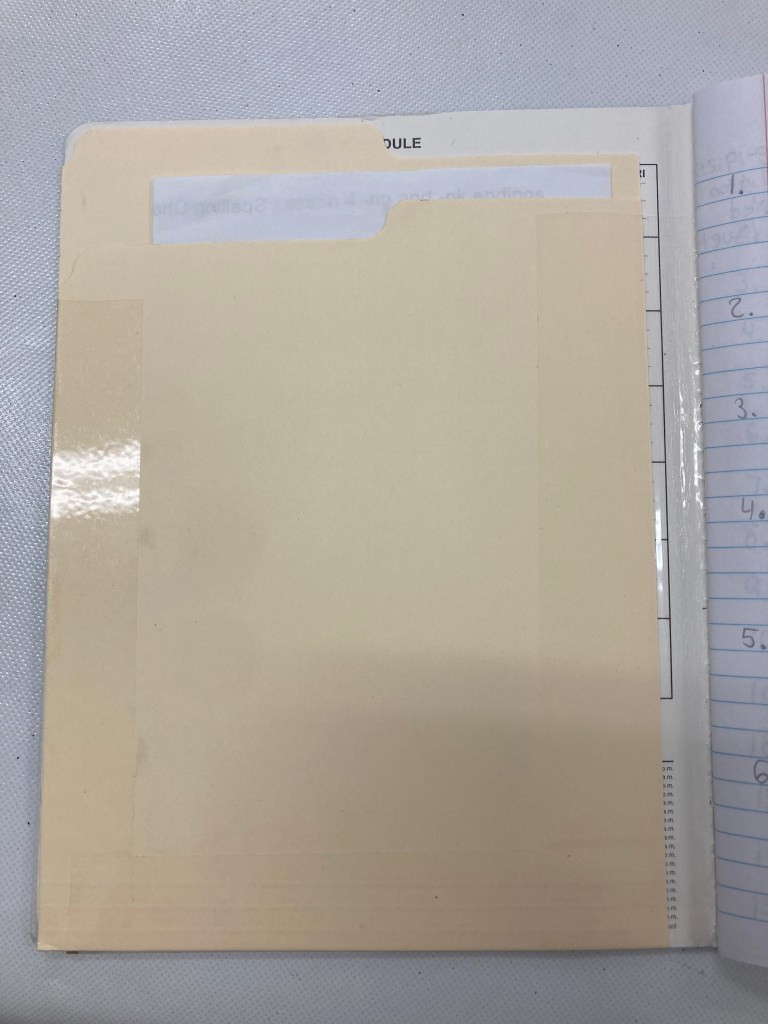
Do your students keep a weekly spelling list inside of a notebook where they write their spelling homework? You’re probably tired of them losing that list all the time because it keeps falling out. Just cut a manilla folder to the length of the notebook and tape it to the inside cover. Now, you have a perfectly sized pocket for the list when it’s folded in half.
Have questions or feedback? Email:
teachgrowsow@gmail.com
 Teach Grow Sow